
Drain & Sewer
Sewer Camera Inspection
The cheapest hour you can spend on a drain problem. It turns a guess about what is buried in your yard into a measured fact.
What is included
What this service covers
What we actually do on this job, and what you can expect us to deal with while we are there.
- Inspecting laterals, main lines and larger branch lines
- Identifying pipe material, diameter and condition
- Finding breaks, offsets, sags, root intrusion and collapses
- Measuring the exact distance from the access to the defect
- Locating and marking the position on the ground above
- Pre-purchase inspections on older properties
- Post-repair verification that work was done properly
Signs to look for
You may need this if you are seeing any of these
- A drain that has blocked more than once in the same place
- Sewage smells outdoors with no obvious source
- A soft, sunken or unusually green strip across the yard
- Being quoted for a sewer replacement without anyone looking first
- Buying a house built before the 1970s with original drainage
- Slow drainage across the whole property rather than one fixture
Why it happens
What usually causes it
01
Symptoms that several faults share
Roots, a sag, an offset joint and a partial collapse can all produce the same recurring backup. They need completely different repairs at completely different costs, and no amount of experience distinguishes them from the surface.
02
Nobody knows what is buried
Records for older laterals in this county are patchy or nonexistent. Material, depth, route and whether there is even a cleanout are frequently unknown until someone looks.
03
Repairs quoted on assumption
The gap between an eight foot spot repair and a full replacement to the street is large. Quoting without footage means pricing the risk, and that risk gets priced into your bill.
Our approach
How we handle this job
Specific to this work rather than a generic checklist bolted onto every page.
01
Find or create access
We work from a cleanout where one exists. Where there is not one, we will discuss the options before doing anything, including whether fitting a cleanout is worth doing as part of the visit.
02
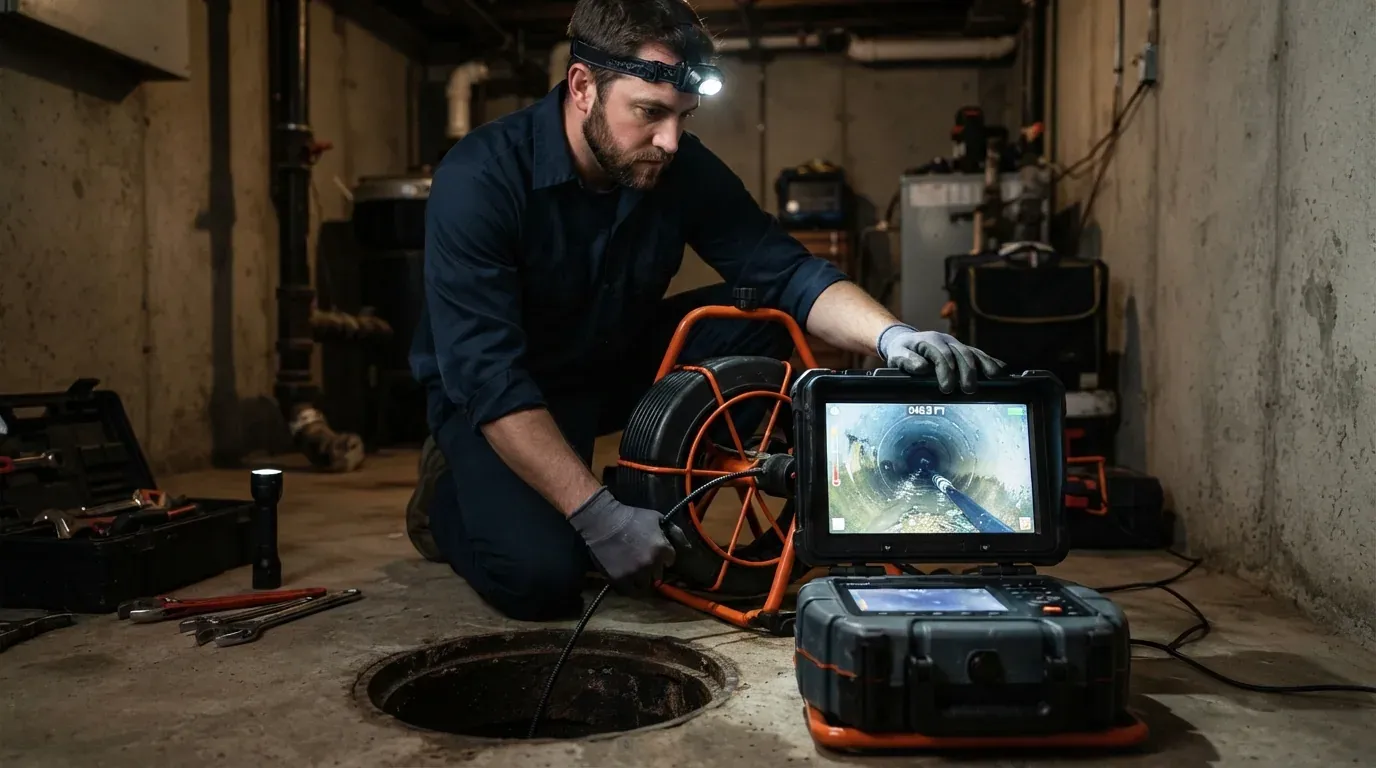
Run the camera the full length
The camera goes down to the connection rather than stopping at the first thing it finds. A line often has more than one issue, and knowing about the second one now is better than discovering it mid-dig.
03
Locate and mark the defect
The camera head transmits its position, which is tracked from above ground. We mark the spot and note the depth, so any excavation goes to one place rather than hunting.
04
Show you and explain it
You see the footage and get a plain explanation of what it shows, including the distance and what it means for cost. If the pipe is fine, we will tell you that.
Why this comes before a quote, not after
There is a reason we put a camera down before pricing sewer work: the same set of symptoms can be produced by four different faults costing wildly different amounts to fix.
Recurring backups in a Lebanon city rowhome might be roots at a clay joint twelve feet out, a scaled cast iron section right at the foundation, or a collapse under the sidewalk. From the basement they look identical. On camera they are unmistakable, and so is the distance to them.
Once that distance is known and marked on the ground, excavation becomes one targeted hole instead of a trench searching for the problem. That is where the money is saved.
What the footage actually tells you
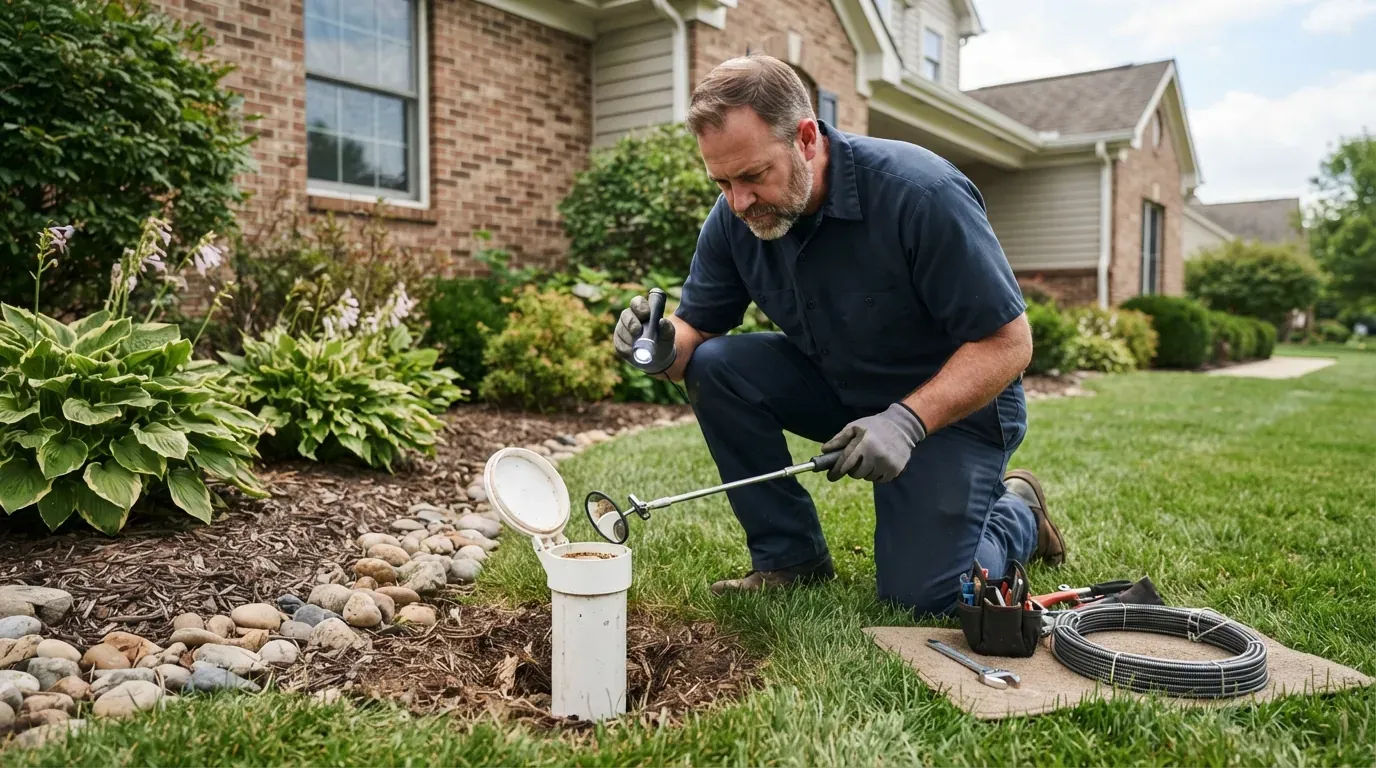
More than most people expect. Pipe material and diameter, the condition of the wall, whether joints have opened or offset, whether there is a low section holding water, how deep the run sits, where it changes direction, and whether there is an accessible cleanout anywhere on it.
It also frequently finds the thing nobody was looking for. A line inspected for roots at thirty feet turns out to also have a sag at fifteen that explains the pattern of blockages far better.
Before you buy an older house here
A standard home inspection does not look inside the buried drainage. On the pre-1970s housing that makes up a large share of Lebanon city and the older borough cores, the lateral is often original, and original in this context means clay or cast iron that has been in the ground a very long time.
A failed lateral discovered after closing is entirely your problem. Discovered before, it is a negotiating point. It is a small check against a large downside.
Questions
Camera inspection questions
Specific to this job. Every service page here has its own, none repeated.
General FAQCommon questions
Can you tell what my pipe is made of from the camera?
How do you know where to dig afterwards?
Is a camera inspection worth it before buying a house?
What if the camera cannot get all the way through?
Will you give me the footage?
My line was cleared and it blocked again. Is that enough reason for a camera?
Do I need a camera inspection if my drains are fine?
Related services
- Sewer line repairThe lateral from your house to the main is the property owner's responsibility in most Lebanon County municipalities. We inspect it before quoting it.
- Drain cleaningClearing a drain is easy. Working out whether it will block again next month is the part that actually saves you money.
- Hydro jettingCabling opens a channel through a blockage. Jetting cleans the pipe wall back to full bore. The difference shows up in how long the line stays clear.
Ready when you are
Need camera inspection in Lebanon County?
Tell us what is going wrong. We come out, look at it properly, and give you the price before anything starts.
- Licensed and insured
- Residential and commercial
- Price agreed before work starts
Talk to a plumber
Tell us what is going wrong and we will arrange a visit.
Rather not call? Request service online
Emergency callouts during business hours