
Water heaters
When to Replace a Water Heater Instead of Repairing It
Find the date on the label and find where the water actually is. Those two answers settle most repair-or-replace decisions before anyone visits.
Published · 6 min read
Water heaters give plenty of warning before they fail properly. The trouble is that the warnings look like minor annoyances, so they get lived with until the day the basement floor is wet.
Two checks answer most of it, and you can do both before anyone comes out.
Find the age on the label
There is a label on the side of the unit with a serial number. For most manufacturers the date of manufacture is encoded in the first four characters, usually as year and week, though the exact scheme varies by brand.
This one number changes the whole conversation.
Under about eight years old, a component fault is usually worth repairing. Elements, thermostats, thermocouples and valves are all reasonable spends on a unit with most of its life ahead of it.
Past ten or twelve years, the calculation shifts. A conventional tank typically lasts eight to twelve years, and hard water shortens that, so a significant repair on a tank at that age often means paying twice within a year or two.
Find where the water is coming from
This is the check people most often get wrong, because water runs across a floor and appears somewhere other than its source.
Water from the fittings on top, from the drain valve, or from the temperature and pressure relief valve discharge pipe means a repairable part. None of those are the tank itself.
Water coming out from underneath the jacket, with everything above it dry, means the steel tank has corroded through. There is no repair for that. A tank that is leaking from the body is finished, and the only question is how soon it gets replaced.
If you are not sure, dry the area completely, put down paper or cardboard, and check it after a few hours. Where the paper wets first tells you a great deal.
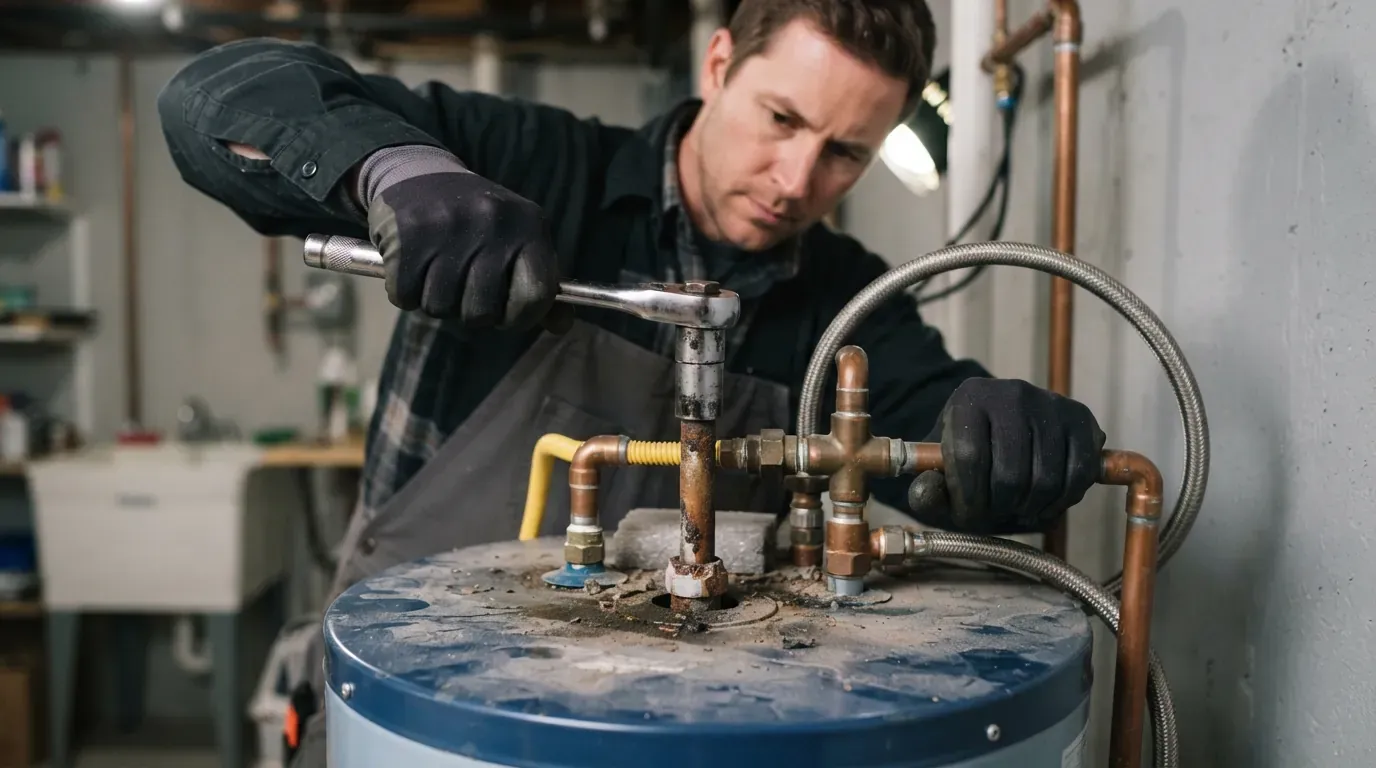
Faults that are worth repairing
Plenty of water heater problems are cheap parts on an otherwise sound unit:
- No hot water on a gas unit: often the pilot, thermocouple or gas valve
- No hot water on electric: frequently a tripped breaker, a tripped high limit reset, or a failed upper element
- Not enough hot water: commonly a failed lower element on electric, or sediment on gas
- Water too hot or lukewarm: usually a thermostat reading incorrectly
- Leaking relief valve: sometimes the valve, sometimes a genuine pressure problem worth investigating
Two of those you can check yourself before calling anybody: the breaker, and the red reset button on the upper thermostat of an electric unit. It is worth thirty seconds.
What hard water does to a tank
This is the local factor, and it matters more here than brand choice does.
Lebanon County sits on limestone, so the water carries a lot of dissolved mineral. When water is heated, that mineral comes out of solution and settles on the bottom of a gas tank or crusts onto the elements of an electric one.
The consequences follow from there. A sediment layer insulates the burner from the water, so the unit runs longer for the same result and your energy use climbs. It takes up volume, so you get less hot water than the tank is rated for. The popping and rumbling on an older tank is water trapped under that layer flashing to steam. On electric units, scale on an element is what burns the element out.
Two habits genuinely extend tank life, and neither is expensive. Flush the tank annually. Check the anode rod every few years and replace it once it is largely consumed, because it is the sacrificial part that corrodes so the tank does not. Once the anode is gone, the tank is next, and that is when rusty hot water starts showing up.
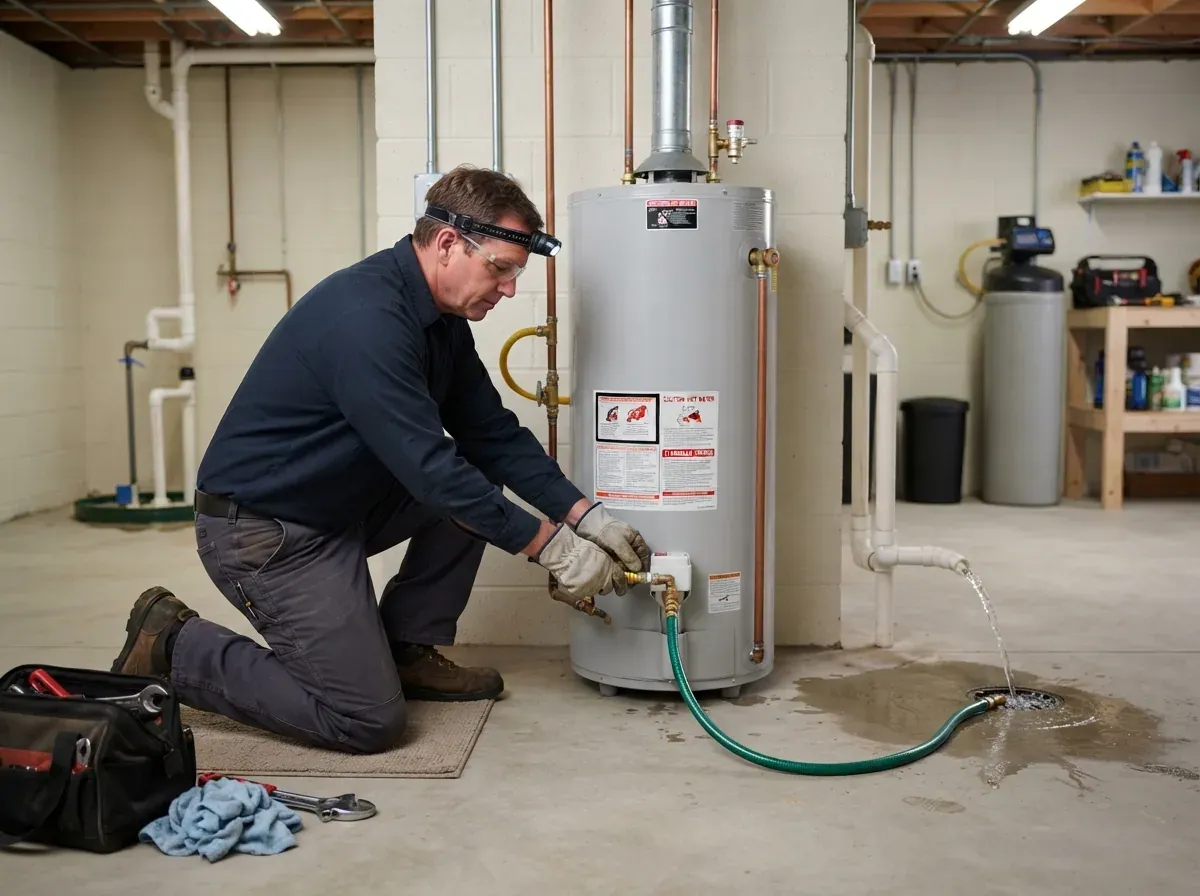
Sizing the replacement
If you are replacing, do not automatically match what was there.
The original was sized for whoever lived in the house at the time. If the household has grown, a bathroom has been added, or you have simply been living with running out of hot water on Sunday mornings, matching the old capacity buys the same problem again.
The measure that matters is peak demand: how much hot water gets drawn in the same hour, not how many bedrooms the house has.
It is also the moment to look at fuel honestly. If the existing unit is electric and gas is already at the property, the running cost comparison is worth doing. If gas is not already there, a conversion rarely pays back on the water heater alone.
Tankless is worth considering if you routinely run out or want the floor space, but it is not a universal upgrade. It often needs gas line and venting work, and in this water it needs descaling more often than the manual suggests.
Two details installers skip
Worth asking about on any replacement quote.
Thermal expansion. If your incoming supply has a pressure reducing valve or a backflow preventer, your plumbing is a closed system. Heated water expands, has nowhere to go, and drives pressure up every cycle, stressing the new tank and every fitting in the house. The answer is an expansion tank, and a lot of older installations here do not have one.
Relief valve discharge. The temperature and pressure relief valve needs its discharge pipe run correctly, terminating where a discharge would be noticed and would not scald anybody. It is one of the most commonly wrong details on existing installations, and a replacement is the right moment to correct it.
The water heater repair page goes into diagnosis in more detail, and replacement covers sizing and installation.